

Left to right: Juan Martínez Carrasco, Chair grant recipient; Raúl Heras Pérez, Chair grant recipient; Vicente Jesús Mayor Gallego, assistant professor; Rafael Estepa Alonso, Chair Director.
The initiative, which in its first edition last year trained two researchers in industrial infrastructure security, is expanding its scope with two new researchers already working on lines focused on OT environments and applied cyber intelligence.
The BeOneSec Cybersecurity and Cyber Intelligence Chair, driven jointly by the University of Seville and BeOneSec, is now into its second research grant edition. Two researchers have been working since this academic year alongside the Department of Telematic Engineering team and BeOneSec specialists on projects with direct application to critical industrial systems.
Two projects addressing one of the sector’s most pressing problems
This edition’s research lines focus on the security of operational technology systems — the systems that control, for example, industrial plants. Environments where a security failure does not mean compromised data, but interrupted essential services.
The first project involves developing an asset inventory and risk analysis system for OT assets following the ISA/IEC 62443 standard, the international reference framework for industrial security.
The second involves building a passive device identification system for industrial networks: a system capable of detecting equipment, firmware versions, and vulnerabilities within a plant without interfering with its operation, supported by lightweight hardware and industrial protocols such as SCADA and Modbus.
What working with real data makes posible
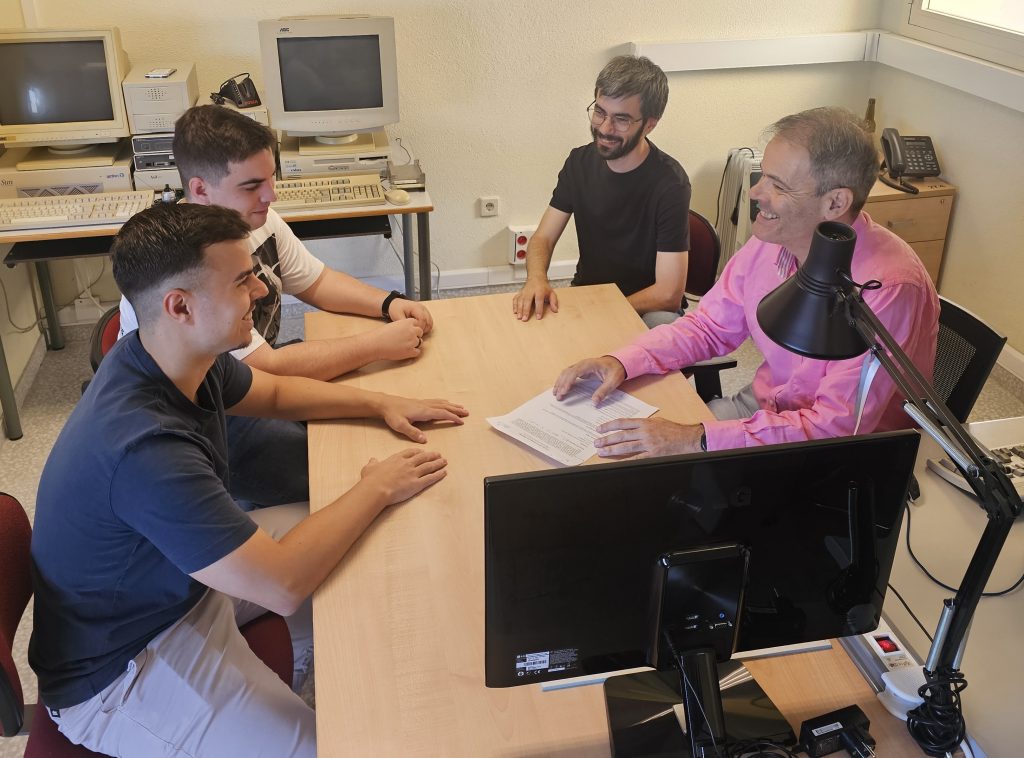
For Rafael Estepa Alonso, Chair Director and Professor in the Department of Telematic Engineering at the University of Seville, these grants address a concrete limitation of the academic environment: “At the University we have the rigour and the methodology. What we struggle to obtain is real data: active attacks, systems in production, threats that are happening right now. BeOneSec has that. The grants are the channel that allows us to bring it together — students research problems that matter, using information that would otherwise never reach the laboratory.”
The researchers themselves confirm it from the inside:
“Even though it is research, from the very first moment it feels like a real project — something with tangible value that can be applied in real scenarios, and through which we can contribute our work towards solving a problem the sector faces right now. It is not a promise for the future; it is effort in the present,” says Raúl Heras.
Juan Martínez adds: “The most valuable thing is not what you learn, but how you learn to learn in an environment where the answers are not in the books. Every week something comes up that you have never seen before.”
A programme that grows on results
The first edition, carried out in 2025, trained two students from the Higher Technical School of Engineering in applied research lines covering threat detection and infrastructure analysis. Both worked with real sector data and case studies for six months. This second edition builds on that precedent and takes on projects of greater technical depth.
The grants are part of the work of the BeOneSec Cybersecurity and Cyber Intelligence Chair, but not the only part. Throughout the academic year, its specialists deliver seminars on the University of Seville’s Master’s in Cybersecurity, contribute to modules on the Telecommunications Engineering degree, and award prizes for the best final-year undergraduate and postgraduate dissertations in the field.
The criterion is always the same: that the knowledge generated in the sector reaches the classroom, so that one day those students can meet the challenges ahead.

